Your Valorant Ping Went From 20ms to 100ms Overnight
Picture this: you're on Ascent, attacking A site as Jett. You line up the dash through A main, ready to entry with a quick one-tap on the Vandal. Six weeks ago, at 15ms ping, this play was second nature. The dash was instant, your crosshair was glued to the corner, and the headshot registered before the defender could even react. That was Valorant in Saudi Arabia — fast, responsive, competitive.
Now? At 100ms ping, you press dash and your character model lingers in A main on the enemy's screen for a full tenth of a second. The defender sees you standing still, lines up a clean headshot, and you die mid-dash. On your screen, you made it through. On the server, you never had a chance.
If you're a Valorant player in Saudi Arabia — whether you're grinding ranked in Riyadh, scrimming in Jeddah, or climbing the ladder in Dammam — your ping skyrocketed in March 2026. You're not imagining it. You didn't suddenly get bad internet. Your ISP didn't downgrade your plan.
Here is what actually happened: Valorant's Middle East servers, hosted on AWS infrastructure in Bahrain (ME-SOUTH-1), went offline due to conflict-related infrastructure damage in March 2026. Riot Games confirmed the disruption and rerouted all Middle East players to Mumbai, India servers (AWS ap-south-1). That single change added roughly 2,300 km of physical distance between your PC and the game server.
Saudi players went from 15-30ms to 80-120ms overnight. Dammam players — who used to enjoy 8-20ms because Bahrain was only 400 km away — got hit the hardest proportionally. The Valorant MENA servers that once gave the Kingdom near-LAN conditions are, for now, gone.
The irony stings. Saudi Arabia's Savvy Games Group has poured billions into gaming and esports. The Esports World Cup in Riyadh featured Valorant on a global stage. Yet Saudi players now have worse latency than European players connecting to the same Mumbai servers. The investment is there. The infrastructure is world-class. The servers simply are not.
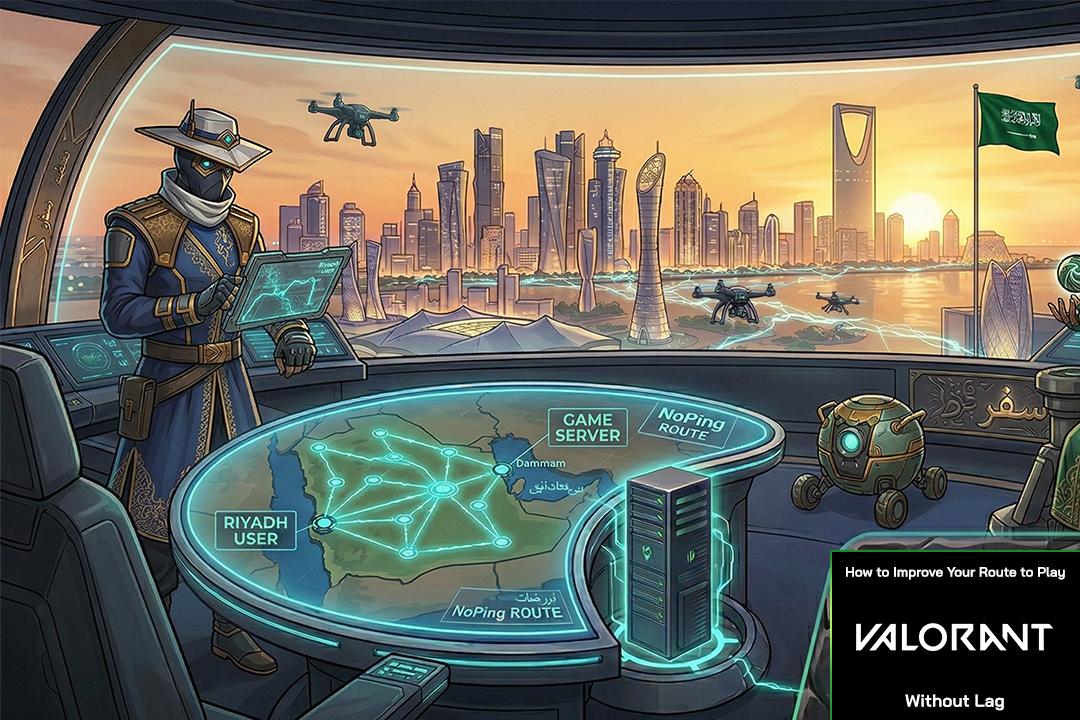
This article explains exactly why your Valorant ping is high in Saudi Arabia in 2026, what 100ms does to your gameplay at a mechanical level, and how NoPing's multi-path routing technology can bring your ping down to 55-75ms — the difference between unplayable and competitive.
NoPing Home Page
What Happened to Valorant's Middle East Servers
In March 2026, military conflict in the Middle East caused physical damage to cloud infrastructure across the region. AWS ME-SOUTH-1 in Bahrain — the data center region that hosted Valorant's Middle East servers — sustained significant damage. Reports indicate water damage from fire suppression systems compounded the initial impact, and AWS used the word "prolonged" when describing recovery timelines, a term Big Tech rarely applies to outages. The mec1-az2 availability zone in the UAE was also destroyed.
The broader infrastructure picture is severe. Seventeen submarine cable systems cross the Red Sea, carrying over 95% of data traffic between Europe, Asia, and Africa. The 2Africa cable — Meta's 45,000 km undersea network — declared force majeure. The cable-laying ship Ile De Batz was stranded at the Dammam coast, unable to reach repair zones. These are not problems that get fixed in weeks.
Riot Games runs Valorant exclusively on AWS. When Bahrain went down, Riot had no choice but to migrate Middle East players to the nearest available AWS region: Mumbai, India (ap-south-1). Riot officially acknowledged the routing issues and high latency for ME players in a support article following the March 2026 disruptions.
Riot Games Support — ME Routing Issues
The math is simple and unforgiving. Riyadh to Bahrain: approximately 400 km. Riyadh to Mumbai: approximately 2,700 km. That is 6-7 times the distance. Your packets now travel through Saudi Arabia's international submarine cables, across the Arabian Sea, and into India. Each hop adds latency, and no ISP upgrade can compress geography.
Why 128-Tick Makes It Worse
Valorant runs its servers at a 128-tick rate — the server takes a snapshot of the entire game state 128 times per second. That means every 7.8 milliseconds, the server expects a fresh update from your client about your position, your aim, your actions.
At 20ms ping, your data arrives well within that tick window. The server has a near-real-time picture of what you're doing. The game feels responsive because the gap between your actions and the server's understanding is tiny.
At 100ms ping, your data is 12 or more ticks late. The server has updated the game state a dozen times since your last input. It is literally playing a different game than what you see on your monitor. This is why Valorant at 100ms feels dramatically worse than games like Fortnite or Apex Legends at the same ping — Valorant was engineered from the ground up for low-latency play, and its 128-tick rate amplifies every millisecond of delay.
What 100ms Ping Actually Does to Your Valorant Matches
Understanding the server migration explains the "why." But Saudi players need to understand the "what" — specifically, what 100ms of latency does to every core mechanic in Valorant. It is not just "slightly worse." Each system in the game breaks down in specific, measurable ways.
Peeker's Advantage Becomes Unfair
At 100ms ping, a player wide-swinging a corner sees you roughly 100ms before you see them on your screen. In most games, that might not matter much. In Valorant, where a single Vandal headshot kills instantly, 100ms is the entire fight.
Consider jiggle peeking — the fundamental information-gathering tool of high-level Valorant. You quickly peek a corner, spot enemy positions, and pull back before they can fire. At 20ms, this works beautifully: you expose yourself for a fraction of a second, gather intel, and retreat. At 100ms, the information you see is 100ms old. By the time the enemy appears on your screen, they have already had 100ms to aim at your character model on their screen. You are dead before your crosshair reaches them. Jiggle peeking, the bread and butter of Diamond and above, becomes a death sentence.
Abilities Become Unreliable
Valorant's agent abilities are designed around split-second timing, and 100ms of delay makes several of them unreliable:
- Jett's Tailwind (dash): This is supposed to be an instant repositioning tool. At 100ms, when you press the dash key, the server still sees your character at the position you occupied 100ms ago. You dash, but on the enemy's screen, your model lingers at the old position for a full tenth of a second. That is more than enough time for a competent opponent to land the headshot on your "ghost."
- Reyna's Dismiss: You secure a kill and immediately press dismiss to become invulnerable and reposition. At 100ms, the kill may register late on the server. The enemy's second bullet — fired at the same time as your lethal shot — arrives at the server before your kill confirms. The server says you died first. Dismiss never activates.
- Chamber's Rendezvous (teleport): The anchor activation has noticeable delay. You teleport expecting to be safe, but the server places you at the anchor point 100ms after you expected, leaving you exposed for a window that did not exist at low ping.
- Flash timing: Your Phoenix Curveball pops 100ms after you think it does. Your team peeks based on your callout, but the flash has not blinded anyone yet. They peek into live gunfire.
Gunplay Falls Apart
The mechanical precision that defines Valorant's gunplay degrades systematically at 100ms:
- Counter-strafing — the technique of tapping the opposite movement key to stop instantly and shoot accurately — requires the server to register your stop command. At 100ms, the server still sees you moving for an extra 100ms after you've stopped on your screen. Bullets fired during that window are flagged as moving-while-shooting, meaning they get the inaccuracy penalty even though your crosshair was still.
- Spray transfer between two targets has a 100ms ghost zone. You kill the first target and drag your spray to the second. But for 100ms, the server still has your crosshair registered on the first target's position. Those mid-transfer bullets hit the wall behind where target one used to be.
- One-taps become coin flips. Your crosshair is precisely on the enemy's head. You click. But the server evaluates your shot against the enemy's position 100ms ago. If they were moving — even slightly — the headshot misses. At 20ms, this discrepancy is negligible. At 100ms, it is a coin flip.
- Wall bangs require knowing where the enemy is behind the wall. At 100ms, the enemy's position data is 100ms stale. At running speed in Valorant, 100ms translates to approximately 25 cm of movement — roughly the width of a character's head. Your perfectly placed wall bang misses by a skull's width.
Competitive Integrity Is Gone
The ranked implications are severe. Saudi players at 100ms are matched against Mumbai-local players sitting at 15ms. That is an 85ms asymmetric advantage in every single gunfight. Premier tournaments are affected — Saudi teams cannot practice at competitive latency. Stallions Esports was disqualified from VCT Challengers 2026 EMEA due to connectivity issues, a direct consequence of the server crisis. Spike plant and defuse timers feel subtly wrong because server and client disagree on timing by 100ms. Riot activated rank protection and RR penalty exemption for MENA players, an acknowledgment that the situation fundamentally breaks competitive integrity.
"Just Switch to Mobily" — Why That Won't Fix Your Valorant Ping
A common suggestion in Saudi gaming communities: switch from STC to Mobily, or from Mobily to Zain. The logic seems sound — maybe a different ISP has better routing to Mumbai. But the reality is that all three major Saudi ISPs route international traffic through similar submarine cable backbone paths.
STC holds approximately 65% of the Saudi market, Mobily around 25%, and Zain about 10%. All three offer fiber-to-the-home and 5G coverage in major cities. Their domestic networks are excellent. The problem is not your ISP — it is the 2,700 km of ocean between your home and the Mumbai server.
Upgrading from 100 Mbps to 1 Gbps fiber will not reduce your ping by a single millisecond. Bandwidth and latency are different measurements. Bandwidth is how many lanes the highway has. Latency is how long the highway is. Adding lanes does not make the road shorter.
5G will not help either. 5G technology reduces last-mile latency — the hop from your device to the nearest cell tower — by roughly 2ms compared to 4G. That is meaningful in some contexts, but irrelevant when the other 98ms of your latency is international routing across thousands of kilometers of submarine cable.
VPNs, despite being the most common suggestion in Reddit threads and Discord servers, typically make the problem worse. A traditional VPN encrypts all your traffic and routes it through a single tunnel to a third-party server before sending it to the destination. That third hop adds 10-30ms of latency on top of what you already have. The Valorant community's VPN-to-Singapore-to-Mumbai workaround sometimes achieves around 70ms, but it is inconsistent and fragile.
The only solution that actually works is smarter routing — finding the fastest path through the internet's maze of submarine cables, peering points, and backbone providers, and doing it in real time.
How NoPing Cuts Your Valorant Ping by 30-40% From Saudi Arabia
NoPing is a game network optimizer — not a VPN, not a simple proxy, but a purpose-built system for reducing gaming latency through intelligent multi-path routing. Here is how each of its core technologies addresses the specific problems Saudi Valorant players face in 2026.
Multi-Path Routing — The Falcon's Instinct
In Saudi Arabia's falconry tradition, a trained saker falcon does not fly in a straight line at its prey. It reads the wind currents, adjusts altitude, shifts trajectory mid-flight, and takes the optimal path to reach its target at maximum speed. The falcon's instinct is to constantly evaluate conditions and adapt — not to commit to a single route and hope.
NoPing applies this same principle to your Valorant packets. Instead of your data taking a single path from your PC through STC's international backbone to Mumbai, NoPing establishes multiple simultaneous paths. Each path routes through different internet backbone providers, different peering points, and different submarine cable connections.
NoPing measures latency on each path in real time — not once at startup, but continuously throughout your gaming session. If Path A through STC's primary international link has 85ms latency but Path B through a secondary peering point shows 62ms, your packets take Path B. If Path B develops congestion five minutes later and Path C through a different backbone drops to 58ms, your packets shift instantly. This is not failover — it is continuous optimization, just like the falcon reading the wind.
The result: instead of a single, potentially congested route giving you 80-120ms with unpredictable spikes, NoPing delivers consistent low ping by always routing through the fastest available path at any given microsecond.
Multi-Internet Bonding — Double Your Routes
Many Saudi households have access to more than one ISP. STC fiber in one room, a Mobily 5G router in another, or Zain as a mobile backup. Most gamers use one or the other. NoPing can bond two ISP connections simultaneously, and this is where the technology becomes particularly powerful for Saudi players.
When you bond STC and Mobily through NoPing, you are not just getting a faster connection — you are doubling the number of available paths to Mumbai. STC and Mobily use different international submarine cable routes, different peering agreements, and different backbone transit providers. That means more route diversity, more options for NoPing to evaluate, and a higher probability that at least one path is running optimally at any given moment.
This matters most during peak hours. Saudi gaming peaks between 8 PM and 11 PM local time, when millions of users are streaming, browsing, and gaming simultaneously. STC's international links get congested. But Mobily's peak congestion pattern may differ by 15-30 minutes, or affect different cable routes entirely. NoPing routes your Valorant packets through whichever ISP has the clearer path right now, switching seamlessly — no disconnects, no lag spikes.
Jitter Elimination — Making 75ms Feel Like 75ms
Here is something most players do not realize: a stable 75ms connection plays significantly better than one that bounces between 60ms and 140ms. The bouncing — called jitter — is often more damaging to gameplay than the raw ping number itself.
Valorant's 128-tick netcode uses interpolation to predict where you are between server updates. It bases this prediction on your average ping. If your ping is a stable 75ms, the prediction is accurate — the server knows where you'll be, and your shots register where you expect. If your ping is jittering between 60ms and 140ms, the server's prediction is constantly wrong. One tick it guesses based on 60ms, the next it recalibrates for 130ms. The result: rubber-banding, ghost bullets, abilities that sometimes register and sometimes do not.
NoPing's jitter stabilization keeps your ping within a tight window of plus or minus 5ms. At 70ms with 5ms jitter, Valorant's netcode can predict your position accurately. Ghost bullets disappear. Rubber-banding stops. Your Jett dash goes where you intended. The game becomes predictable again — and predictability is the foundation of competitive play.
Vanguard Compatible — Zero Ban Risk
Riot Vanguard is Valorant's kernel-level anti-cheat system. It loads at boot, monitors system processes, and flags anything that interferes with the game client. Understandably, Saudi players worry about whether NoPing could trigger a false detection.
NoPing operates entirely at the network routing level. It does not modify game files, inject code into processes, hook into the kernel, or alter Valorant's memory. From Vanguard's perspective, NoPing's traffic looks exactly like normal network packets taking a different internet route — because that is precisely what it is. Thousands of players use NoPing daily alongside Vanguard without any bans or flags. NoPing is fully compatible with Valorant's anti-cheat.
Realistic Numbers for Saudi Arabia
NoPing cannot break the laws of physics. The distance from Riyadh to Mumbai is approximately 2,700 km. Light traveling through fiber optic cable moves at roughly 200,000 km/s, giving a theoretical minimum round-trip time of about 27ms. Real-world routing will always add overhead above that minimum.
Here is what Saudi players can realistically expect with NoPing:
| City | Without NoPing | With NoPing | Improvement |
| Riyadh | 80-120ms | 55-75ms | 25-45ms reduction |
| Dammam / Khobar | 80-110ms | 50-70ms | 30-40ms reduction |
| Jeddah | 90-120ms | 60-80ms | 30-40ms reduction |
That 30-40ms reduction is the difference between an unplayable connection where every gunfight feels like a coin flip and a competitive connection where your skill determines the outcome. It will not feel like the 15-20ms glory days of Bahrain servers, but 60ms stable is a connection you can climb ranked on.
NoPing Pricing Page
How to Set Up NoPing for Valorant in Saudi Arabia
Setting up NoPing takes less than five minutes. Here is the step-by-step process:
- Download NoPing from noping.com/download. The installer is lightweight and runs on Windows.
- Create an account or log in if you already have one.
- Select "Valorant" from the game list in the NoPing app.
- Choose server: Mumbai (ap-south-1) — this is where Middle East players are currently routed. Bahrain and Dubai servers are not showing up because the infrastructure is offline.
- Click "Optimize." NoPing tests multiple paths from your location to Mumbai and selects the fastest combination.
- Launch Valorant normally through the Riot Client. NoPing works in the background.
- Verify your ping in-game. Go to Settings, then Video, then enable Network Stats. Alternatively, press Ctrl+Shift+N during a match to see your live ping overlay.
Pro tip for multi-Internet bonding: If you have two ISP connections — for example, STC fiber and a Mobily 5G router — connect both to your PC or router before launching NoPing. The application automatically detects multiple connections and bonds them. For the best results, connect your primary ISP via ethernet cable and your secondary ISP via WiFi or a second ethernet cable through a dual-WAN router.
You should see your ping drop and, more importantly, stabilize within the first few minutes. Test in a Deathmatch or Spike Rush before jumping into Competitive to get a feel for the improved connection.
NoPing Download Page
The key differentiator is multi-path routing combined with multi-Internet bonding. Tools like ExitLag, WTFast, LagoFast, GearUp Booster, Mudfish, and Haste all optimize a single route. NoPing sends packets across multiple routes simultaneously and uses whichever arrives first. Combined with the ability to bond two Saudi ISPs — a feature no competitor offers — NoPing provides route diversity that single-path optimizers simply cannot match.
It is also worth addressing the "best VPN for Valorant Saudi Arabia" search that many players make. A VPN is fundamentally the wrong tool for this problem. VPNs are designed for privacy and geo-unblocking, not latency reduction. They encrypt all traffic, add a third routing hop, and almost always increase your ping. NoPing is a game network optimizer — purpose-built to reduce latency for specific games, not to hide your IP address.
NoPing vs ExitLag Comparison
Frequently Asked Questions — Valorant Ping in Saudi Arabia
Q: Will Riot bring back Middle East servers?
A: Riot has not announced a specific timeline for restoring Middle East servers. The recovery depends on AWS rebuilding ME-SOUTH-1 infrastructure in Bahrain, and AWS has described that timeline as "prolonged." Realistically, this could take months. There are rumors of new Riyadh servers in the community, but nothing has been confirmed by Riot or AWS. NoPing is the practical solution for right now — it works today, and when ME servers return, you can simply stop using it.
Q: Can NoPing get me back to 15-20ms ping?
A: No, and any tool that promises sub-30ms ping from Saudi Arabia to Mumbai is not being honest. A 15-20ms ping is only physically possible with servers in Bahrain or a nearby Gulf location. The speed of light in fiber optic cable limits Riyadh-to-Mumbai round trip to a theoretical minimum of approximately 27ms. NoPing can get you to 55-75ms by eliminating routing inefficiency and jitter, which is competitive enough for ranked play up through Radiant.
Q: Does NoPing work with Riot Vanguard?
A: Yes. NoPing operates at the network routing level — it optimizes the path your packets take through the internet. It does not touch the Valorant game client, modify game files, inject code, or interact with the kernel. Riot Vanguard sees completely normal network traffic. Thousands of players worldwide use NoPing daily without a single ban related to the software.
Q: Will NoPing work with STC / Mobily / Zain?
A: Yes, all three major Saudi ISPs are fully supported. NoPing works with any internet connection. For maximum performance, bond two ISPs together — for example, STC fiber and Mobily 5G — to give NoPing the greatest number of routing paths to test and optimize.
Q: Does NoPing affect my FPS?
A: NoPing can actually improve FPS slightly. By optimizing network packet handling, it reduces the CPU overhead associated with network operations, freeing up resources for Valorant's rendering engine. NoPing's own CPU usage is minimal — approximately 0.5% on modern hardware.
Q: Is NoPing a VPN?
A: No. VPNs encrypt all your internet traffic through a single tunnel, which adds latency. NoPing is a game network optimizer that uses multi-path routing specifically for game traffic — it tests multiple internet routes simultaneously and sends your packets on the fastest one. The result is reduced latency instead of added latency. NoPing does not change your IP address, encrypt your browsing, or affect any traffic outside of the game you're optimizing.
Q: Can I use NoPing for Valorant Premier and VCT qualifiers?
A: Yes. NoPing is permitted in all official Valorant competitive modes, including Competitive ranked, Premier, and open VCT qualifiers. It does not modify game files, inject into game memory, or alter any game data. It is a network optimization tool, comparable to choosing a better ISP route — which is exactly what it does.
Saudi Arabia Deserves Better Valorant Servers — Until Then, There's NoPing
Saudi Arabia has invested more in gaming and esports than perhaps any nation on earth. The Esports World Cup brought the world's best Valorant teams to Riyadh. Savvy Games Group's billions signal a long-term commitment to making the Kingdom a global gaming capital. The passion is real — the average Saudi gamer plays over 8 hours per week, and Valorant is firmly in the top three competitive titles alongside League of Legends and Fortnite.
The server situation is temporary. AWS will rebuild. Riot will restore ME servers. The infrastructure damage from March 2026 is severe, but it is not permanent. The question is what you do in the meantime. Every ranked match played at 100ms with jitter is a match where your skill is not the deciding factor. Every RR point lost to desync, ghost bullets, and ability delays is a point that did not have to be lost.
NoPing will not replace local servers. Nothing can, until they come back. But it makes Mumbai playable for competitive Valorant. It turns 80-120ms with unpredictable spikes into 55-75ms with rock-solid stability. It takes a connection where every gunfight feels rigged and gives you one where your aim, your movement, and your game sense determine the outcome.
Download NoPing. Set it up before your next competitive match. Feel the difference in your first Jett dash, your first one-tap, your first counter-strafe. Then decide.
Try NoPing free for Valorant — download at
noping.com/download
NoPing Download Page
```