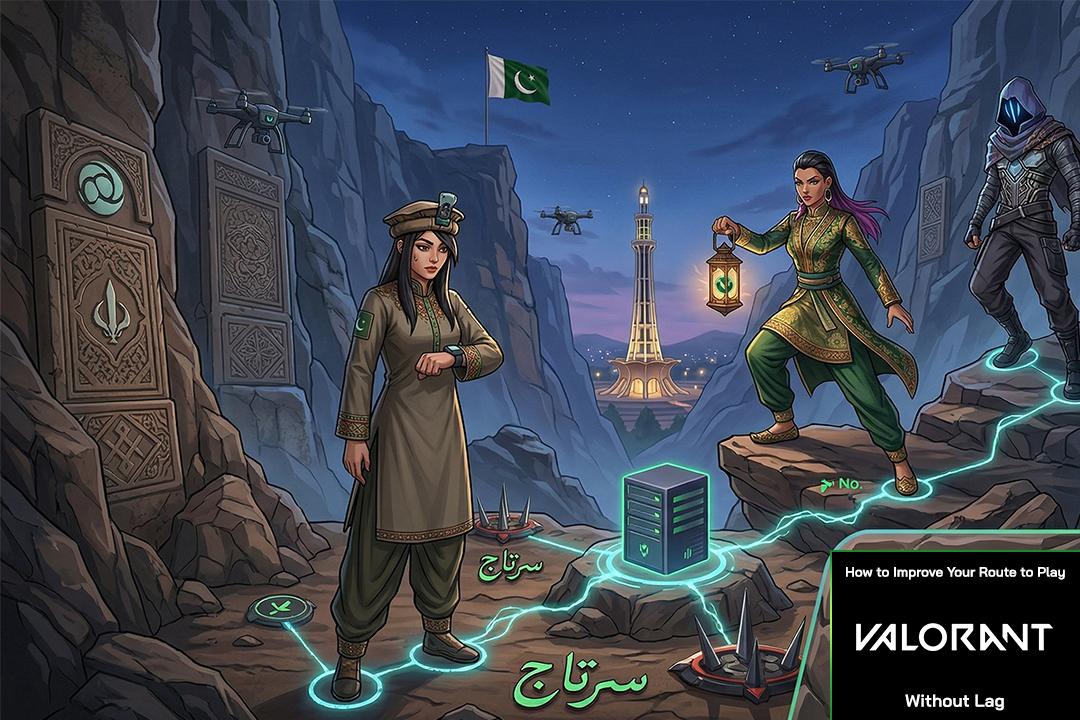
Pakistan Is 1,000km From Mumbai — So Why Is Your Valorant Ping 120ms?
Pull up a map. Find Karachi. Find Mumbai. They are separated by roughly 1,000 km of Arabian Sea. That is closer than Riyadh to Bahrain — the route that gave Saudi players 15-30ms ping for years.
At the speed of light through fiber optic cable (approximately 200,000 km/s), 1,000 km translates to roughly 10ms round trip. Add realistic routing overhead — multiple hops through switches, routers, and exchange points — and Pakistan should have 30-60ms ping to Mumbai. That is competitive. That is playable. That is better than what most Gulf countries can dream of after the server migration.
But Pakistani Valorant players are reporting 100-150ms to Mumbai. Some in Lahore see 130ms or higher. Meanwhile, players in Oman — 1,800 km from Mumbai — get 80ms. Players in Dubai — 2,000 km away — get 70ms. Pakistan is closer than both, yet has worse ping than either.
Something is deeply, fundamentally broken with how Pakistan's ISPs route traffic to India.
This is not the same story as Saudi Arabia, UAE, or Kuwait. Those countries lost nearby servers and were forced to connect across thousands of extra kilometers. Pakistan actually won the geographic lottery with the migration to Mumbai — India is right next door. But broken ISP routing is stealing that advantage, turning what should be a 40ms connection into a 120ms nightmare.
This article explains exactly why your ping is broken, which ISPs are causing it, and how NoPing fixes the routing problem to deliver the 40-70ms connection Pakistan's geography should provide.
Your Packets Are Taking a 6,000km Detour — Here's Why
PTCL's Singapore Detour
PTCL (Pakistan Telecommunication Company Limited) is Pakistan's dominant ISP with approximately 40% of the fixed broadband market. It is state-owned, controls most backbone infrastructure, and connects Pakistan to the outside world through submarine cables landing at Karachi.
Here is the problem: PTCL routes international traffic to India through submarine cables that go to Singapore first, then route back to Mumbai. The path your Valorant packets take:
Karachi to AAE-1 or IMEWE submarine cable to Singapore to Mumbai
That is approximately 6,000 km instead of the direct 1,000 km. Your packets literally travel six times the necessary distance. They sail east across the entire Indian subcontinent, reach Southeast Asia, and then route back west to Mumbai. It is like driving from Lahore to Islamabad via Peshawar — technically possible, but absurdly inefficient.
Why does PTCL do this? The answer is complex transit peering agreements. PTCL's cheapest international bandwidth deals route through Asian hub cities. Direct Pakistan-India internet peering has historically been limited due to geopolitical factors, and the cost of establishing direct peering has not been prioritized for gaming traffic. PTCL optimizes for cost, not for latency.
Why Other Pakistani ISPs Are Not Much Better
- Nayatel: Genuinely better international routing than PTCL, with smarter peering arrangements. But Nayatel only serves three cities — Islamabad, Rawalpindi, and Faisalabad. Pakistan's two largest cities (Karachi at 15 million, Lahore at 11 million) have zero Nayatel coverage.
- StormFiber: Growing fiber provider with decent routing in Karachi and Lahore. Better than PTCL for many international routes, but limited backbone capacity means performance degrades during peak hours.
- Jazz, Telenor, Zong (mobile operators): All three are 4G-only. Pakistan has no 5G deployment. Mobile internet routes through the same international submarine cables as fixed broadband, adding 30-50ms of last-mile latency on top of the international routing detour. On PTCL's route via Singapore plus 4G last-mile, total ping reaches 150-200ms. Unplayable.
The Numbers That Prove It Is Routing, Not Distance
| Measurement | Value |
| Lahore to Mumbai distance | ~1,500 km |
| Expected ping (distance-based) | 35-55ms |
| Actual PTCL ping | 100-150ms |
| Routing waste | 60-95ms of pure inefficiency |
For comparison: Dubai to Mumbai is 2,000 km — further than Lahore — yet Dubai players achieve 50-70ms with good routing. Pakistan is closer but has worse ping. That is not a physics problem. That is a routing scandal.
How PTCL's Routing Turns Your Valorant Games Into Coin Flips
The frustrating part is not just the high ping — it is knowing you should not have high ping. Every death at 120ms feels like a robbery because, geographically, you are sitting closer to the server than half the players killing you.
- Peeker's advantage: Indian players on Mumbai servers have 15-30ms. You have 120ms. They see you 90ms before you see them. In a one-tap game where a Vandal headshot kills instantly, 90ms of advantage is the entire fight. You are not losing because you aimed worse. You are losing because the server showed them your position before it showed you theirs.
- Counter-strafing: At 120ms, the server registers your stop command too late. You press the opposite movement key, your screen shows you standing still, but the server still sees you moving for another 120ms. Bullets fired during that window get the inaccuracy penalty. Your perfect counter-strafe becomes an inaccurate spray on the server.
- Abilities: Jett dash, Reyna dismiss, Chamber teleport — all delayed by 120ms. Your defensive reactions are slower than the enemy's offensive actions by definition. At 40ms (what Pakistan should have), these abilities would feel responsive and competitive.
- Spray transfer: Your crosshair moves to the second target. But for 120ms, the server still registers your aim at the first target's position. Those transfer bullets hit empty air. A lifetime at 128-tick rate.
- Ranked reality: Pakistani players compete against Indian players who sit at 15-30ms. At 120ms, you need to be significantly more skilled than your opponent just to maintain the same rank. You are playing with a permanent handicap that has nothing to do with your aim, your game sense, or your hardware.
- The mobile problem: Many Pakistani gamers' backup connection is 4G mobile. On mobile internet, add another 30-50ms of last-mile latency to PTCL's already broken routing. Total: 150-200ms. That is not Valorant — that is a slideshow.
"Switch to Nayatel" — Great Advice If You Live in 3 Cities
The standard community advice for Pakistani Valorant players is to switch ISPs. The advice is not wrong in principle — Nayatel does have better routing. The problem is availability.
Nayatel serves exactly three cities: Islamabad, Rawalpindi, and Faisalabad. Pakistan's two largest gaming populations — Karachi (15 million people, closest city to Mumbai) and Lahore (11 million people, massive gaming community) — cannot get Nayatel. If you are in Karachi or Lahore, Nayatel is not an option.
StormFiber is growing and offers decent routing in select areas of Karachi and Lahore, but its coverage is patchy and backbone capacity is limited. During evening peak hours when most players are online, StormFiber's routing advantage shrinks.
All mobile ISPs — Jazz, Telenor, Zong — share similar international submarine cable routing. They connect to the same underwater cables at the same landing points in Karachi. Switching mobile carriers changes nothing about international routing. And without 5G anywhere in Pakistan, mobile connections add 30-50ms of base latency that fixed broadband avoids.
Even switching ISPs often means using the same submarine cables. The AAE-1 and IMEWE cables that PTCL uses are the same cables available to other providers at Karachi's landing station. Pakistan needs smarter routing through those cables, not a different ISP connecting to the same cables the same way.
NoPing Finds the Shortcut Your ISP Won't — Like a Truck Art Driver
The Truck Art Routing Analogy
Pakistan's iconic painted trucks are more than folk art — they represent generations of road knowledge. A veteran truck art driver on the Grand Trunk Road does not sit in the traffic jam on the main highway between Lahore and Islamabad. He knows the back road through the village that bypasses the toll plaza. He knows the shortcut past the checkpoint that saves 40 minutes. He knows which mountain pass to hit before sunrise to avoid the afternoon rush.
While other drivers follow GPS straight into gridlock, the truck art driver arrives first because he knows routes the system does not show.
NoPing is the truck art driver for your Valorant packets. While PTCL sends them on the congested six-lane highway through Singapore, NoPing finds the direct shortcut to Mumbai that your ISP refuses to use.
How NoPing Fixes Pakistan's Routing
NoPing maintains a network of routing servers and peering relationships across Asia. Instead of your packets following PTCL's default path:
- Without NoPing: Your PC to PTCL to Singapore to Mumbai (~6,000 km, 120ms)
- With NoPing: Your PC to PTCL to NoPing's nearest routing node to direct path to Mumbai (~1,000-1,500 km, 40-70ms)
The key difference: NoPing has direct peering arrangements with Indian network providers that PTCL does not use. Where PTCL takes the cheapest transit route through Singapore, NoPing routes through direct submarine cable connections and closer exchange points.
NoPing also tests multiple alternative paths in real time:
- Path A: Direct submarine link to western India
- Path B: Through Oman landing point to Mumbai
- Path C: Through UAE exchange point to Mumbai
Whichever path is fastest right now carries your packets. The optimal path can change hundreds of times per second — NoPing adapts continuously.
Multi-Internet Bonding — PTCL + 4G Backup
Pakistan lacks 5G, but NoPing can still bond PTCL's fixed connection with a 4G mobile backup from Jazz, Telenor, or Zong.
The 4G connection adds 30-50ms of last-mile latency, which is not ideal. But as a backup through NoPing's optimized international routing, 4G can sometimes outperform PTCL's default Singapore detour. If PTCL has a routing congestion spike during evening peak hours (8-11 PM PKT — exactly when most players are online), the 4G path through a different submarine cable segment might actually be faster.
NoPing automatically selects the best option — it might route through PTCL's fiber with optimized international routing for nine packets out of ten, then use 4G's different cable for the tenth when PTCL spikes. The bonding is transparent and seamless.
Jitter Stabilization
PTCL is notorious for jitter. Ping does not sit at a stable 120ms — it bounces between 80ms and 160ms unpredictably. This destroys Valorant's 128-tick netcode predictions, causing rubber-banding, ghost bullets, and ability desync on top of the already high base latency.
NoPing stabilizes jitter to a window of plus or minus 5-8ms. Even at 55ms average, a stable connection plays vastly better than 120ms with 40ms of jitter. Valorant's prediction model works. Shots register where you aimed. Abilities activate when you pressed the key.
Vanguard Compatible
NoPing operates at the network routing level — invisible to Riot Vanguard. No game client modifications, no kernel hooks, no process injection. Zero ban risk.
Expected Results — What Pakistan's Geography Actually Supports
| City | Without NoPing | With NoPing | Improvement |
| Karachi | 100-140ms | 35-55ms | 65-85ms reduction |
| Lahore | 110-150ms | 45-65ms | 65-85ms reduction |
| Islamabad | 120-150ms | 50-70ms | 70-80ms reduction |
These numbers represent what Pakistan's ping should be based on actual physical distance. NoPing is not performing magic — it is delivering the connection your geography entitles you to, the connection your ISP should provide but does not.
Karachi players benefit most: at approximately 1,000 km from Mumbai, 35-55ms with NoPing is a connection that competes with — and sometimes beats — what UAE and Saudi players achieve after optimization.
NoPing Download Page
How to Set Up NoPing for Valorant in Pakistan
Standard Setup
- Download NoPing from noping.com/trial
- Create an account or log in
- Select "Valorant" from the game list
- Choose server: Mumbai (ap-south-1)
- Click "Optimize" — NoPing tests routes and finds the direct path to Mumbai
- Launch Valorant through the Riot Client
- Check ping in-game: Settings, Video, Network Stats. Or press Ctrl+Shift+N.
Dual-Connection Setup
- Connect PTCL fiber or DSL via ethernet cable
- Connect Jazz, Telenor, or Zong 4G via WiFi hotspot or USB dongle
- NoPing auto-detects both connections
- Enable "Multi-Internet" bonding in NoPing settings
- NoPing intelligently routes across both — no manual switching needed
Pro tip for Karachi players: If you have StormFiber available in your area, bond it with PTCL for maximum route diversity. StormFiber often has better peering to Indian networks than PTCL, giving NoPing even more high-quality paths to work with.
Internet cafe players: NoPing runs on your personal account. Install it on the cafe PC, log in, optimize, and play your session. It works with any internet connection the cafe provides.
The critical difference for Pakistan is route optimization. Tools like ExitLag and WTFast can improve routing somewhat, but NoPing's direct peering relationships with Indian networks and real-time multi-path testing deliver the most aggressive routing improvement — the full 60-85ms reduction that Pakistan's geography supports.
For players searching "best VPN for Valorant Pakistan" or "Pakistan gaming VPN": a VPN is the wrong tool. VPNs add encryption overhead and a third routing hop, typically increasing ping by 10-30ms. NoPing is a game network optimizer that finds direct routes, reducing latency instead of adding it.
FAQ — Valorant Ping in Pakistan
Q: Why is my ping to Mumbai WORSE than my old ping to Bahrain?
A: Because Pakistani ISPs route traffic to Mumbai through Singapore instead of taking the direct 1,000 km path across the Arabian Sea. The old Bahrain routing went through Middle Eastern cables that, paradoxically, were shorter paths for Pakistan than PTCL's current Singapore detour. NoPing fixes this by finding the direct route your ISP refuses to use.
Q: Will 5G help when Pakistan gets it?
A: 5G would reduce last-mile latency by 20-40ms compared to 4G, which would help mobile players significantly. But the core international routing problem remains. Even with 5G, if PTCL still routes through Singapore, you would still need NoPing to get the direct path to Mumbai. 5G plus NoPing would be the ideal combination.
Q: Is Nayatel better for Valorant than PTCL?
A: Nayatel generally has better international routing, so yes — if it is available in your city. But Nayatel only serves Islamabad, Rawalpindi, and Faisalabad. If you are in Karachi or Lahore, it is not an option. NoPing helps even Nayatel users by finding optimal paths, but the improvement is most dramatic for PTCL users.
Q: Can NoPing really get me 35-55ms in Karachi?
A: Yes. The physics supports it: 1,000 km distance at fiber optic speed gives a theoretical base of approximately 10ms round trip. With real-world routing overhead, 35-55ms is exactly what this distance should deliver. NoPing achieves this by bypassing the Singapore detour and routing directly to Mumbai.
Q: Does NoPing work with Riot Vanguard?
A: Yes. Network-level routing optimization, completely invisible to Vanguard. No game modifications, no kernel interference. Zero ban risk.
Q: Does NoPing work on 4G mobile internet?
A: Yes, but 4G adds 30-50ms of base last-mile latency. With NoPing optimizing the international routing, expect 70-100ms on 4G — significantly better than PTCL's unoptimized 120ms, but not as good as fixed broadband with NoPing. For the best results, use fixed broadband (PTCL, Nayatel, or StormFiber) as your primary connection.
Q: Can I use NoPing at an internet cafe?
A: Yes. NoPing runs on your personal account credentials. Install on the cafe PC, log in, select Valorant, optimize, and play. It works with any internet connection.
Q: Why don't Pakistani ISPs just route directly to India?
A: Several factors: limited Pakistan-India peering agreements at submarine cable landing points, cheaper transit deals available through Singapore and other Asian hubs, and historical geopolitical factors that have limited direct infrastructure cooperation. These are ISP-level business decisions that prioritize cost over gaming latency. NoPing bypasses these limitations by maintaining its own peering relationships with Indian networks.
Pakistan Doesn't Have a Distance Problem — Fix the Routing, Fix the Ping
Pakistan is the only country in this entire Middle East server migration story where the move to Mumbai should have improved ping. Karachi to Mumbai: 1,000 km. Lahore to Mumbai: 1,500 km. These are distances that support competitive, playable Valorant connections.
The real enemy is not Riot Games. It is not AWS. It is not the conflict that damaged Bahrain's data centers. For Pakistani players, the enemy is broken ISP routing — a 6,000 km detour through Singapore that transforms a 40ms connection into a 120ms nightmare.
NoPing does what Pakistan's ISPs will not: route your packets directly to Mumbai through the shortest available path. It delivers the connection your geography entitles you to — the connection that should have made Pakistan one of the biggest winners of the Mumbai migration, not one of the biggest losers.
Karachi to Mumbai: 1,000 km. 35-55ms achievable with NoPing. Stop accepting 120ms.
Download NoPing and take the shortcut —
noping.com/trial
NoPing Download Page